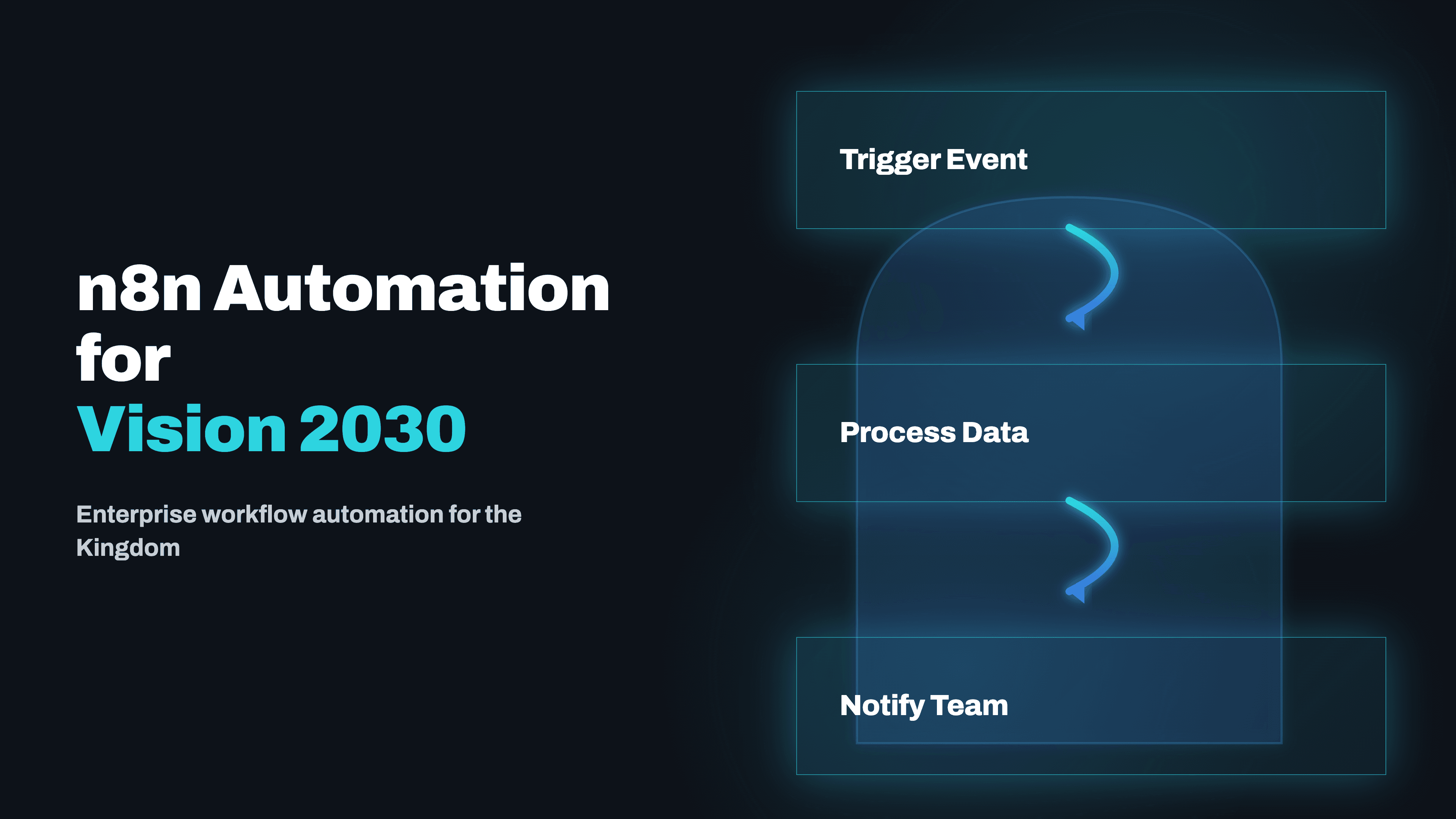
Vision 2030 isn't just a government initiative, it's creating real procurement and compliance pressure for Saudi enterprises to show digital transformation progress. Self-hosted n8n is the right tool for Saudi deployments: no data leaves the kingdom, no per-operation cloud pricing, full control.
Saudi Arabia's Vision 2030 programme has moved from policy document to procurement reality. For enterprise technology leaders in the Kingdom, in logistics, healthcare, financial services, or government-adjacent sectors, demonstrating digital transformation progress is no longer optional. It is a commercial requirement tied to licensing, government contracts, and investor expectations. n8n, deployed on-premise or in-kingdom cloud infrastructure, has emerged as the automation platform of choice for Saudi enterprises that need to move fast without compromising on data sovereignty.
Why Vision 2030 Is Creating Enterprise Automation Urgency
The National Strategy for Data and AI allocated $20 billion toward AI infrastructure, but the urgency for private sector enterprises comes from a more immediate source: procurement frameworks. Government tenders and large public-private partnership contracts increasingly require bidders to demonstrate AI capability and digital operations maturity. Saudi Aramco, SABIC, and the giga-projects (NEOM, Red Sea, Diriyah) all require their supply chain partners to operate with modern digital systems.
The enterprises we work with in Riyadh and Jeddah are building automation systems because they have a commercial deadline, not because automation is interesting.
Why Self-Hosted n8n Fits Saudi Data Residency Requirements
Saudi Arabia's Personal Data Protection Law (PDPL) and the broader regulatory environment around sensitive business data create real constraints on cloud-based automation platforms. When your automation workflow processes employee records, customer financial data, or government-related information, sending that data to a US-based SaaS platform introduces compliance exposure. Self-hosted n8n eliminates that exposure entirely.
Deployed on an in-kingdom data centre, AWS Riyadh, Azure Saudi Arabia, or an on-premise server, your n8n instance processes all data without it leaving the jurisdiction. You get the full power of n8n's 400+ integrations, the Code node for custom logic, and the AI agent framework, with zero data leaving the Kingdom.
Top Automation Use Cases in Saudi Enterprises
- ✓Logistics and supply chain: n8n workflows connecting SAP or Oracle supply chain systems to carrier APIs and customs portals cut exception handling time by 60–70% in our deployments
- ✓HR and government compliance: Saudization (Nitaqat) compliance tracking, GOSI reporting, and Mudad payroll integration, all highly rule-based and well-suited to automation
- ✓Finance and billing: automated invoice processing, three-way matching against purchase orders and GRNs, SAP posting, and approval routing for amounts above defined thresholds
- ✓Government procurement portals: automated monitoring of Etimad and other portals, with AI-generated summary briefs delivered to the business development team within minutes of publication
Arabic Language Handling in Automation Pipelines
Arabic language processing is where most off-the-shelf automation platforms fall short in the Saudi market. Arabic is morphologically complex, a single root word generates dozens of derived forms, and the mixture of Modern Standard Arabic, Gulf dialect, and Arabic-transliterated English in business documents creates real parsing challenges.
In n8n workflows that need to read, classify, or generate Arabic-language content, we use a combination of Claude or GPT-4o (both handle Arabic well at the API level) with carefully engineered system prompts. For high-volume document processing, invoice OCR from Arabic-language vendors, contract clause extraction from Arabic legal documents, we combine Tesseract with custom Arabic OCR fine-tuning and LLM-based correction.
Arabic document processing reaches 94–97% accuracy in production, compared to the 70–80% accuracy of generic OCR pipelines on Arabic text.
How Kodesinc Structures Saudi Engagements
Working with Saudi enterprises requires more than technical capability, it requires understanding the procurement culture, decision-making structure, and timeline expectations. Our Saudi engagements follow a fixed structure:
- ✓2-week discovery phase: workflow mapping, data flow identification, data residency architecture confirmation
- ✓Fixed-scope delivery: Saudi enterprise clients expect clear scope, not time-and-materials ambiguity, we provide a scoping document with fixed deliverables and timelines
- ✓4–6 week development sprints: with working demos at each milestone
- ✓Bilingual documentation: English and Arabic, with Riyadh business hours availability for all active engagements
Results: What Saudi Enterprises Are Seeing
- ✓Data sovereignty: 100% in-kingdom data processing with self-hosted n8n on AWS Riyadh or Azure Saudi
- ✓Arabic language: 94–97% accuracy on Arabic document processing in production deployments
- ✓Saudization compliance: automated Nitaqat tracking and GOSI reporting workflows
- ✓Supply chain: 60–70% reduction in logistics exception handling time
- ✓Government procurement: automated tender monitoring across Etimad and related portals
Procurement Intelligence Automation: A Growing Saudi Use Case
One of the fastest-growing automation use cases we're seeing in Saudi enterprise is government procurement intelligence. Saudi Arabia's Etimad platform and related government procurement portals publish hundreds of tenders per week across infrastructure, technology, healthcare, and services. For any company that sells to government entities or public-private partnership projects, tracking and evaluating these tenders manually is a full-time job.
We build automated procurement intelligence systems that monitor Etimad and relevant sector-specific portals, classify tenders by sector, value, and eligibility criteria, extract key requirements and deadlines, and deliver AI-generated summary briefs to the business development team within minutes of publication. Teams using these systems review and evaluate 5x more tender opportunities with the same headcount.
Integration Architecture for Saudi Enterprise Systems
Saudi enterprises run a different technology stack than their Western counterparts. Oracle Fusion ERP is more common in large Saudi conglomerates than SAP, though both are present. Muqeem for expatriate workforce management, Mudad for payroll compliance, and GOSI for social insurance contributions are local systems that most off-the-shelf Western automation platforms have no native connectors for.
n8n's HTTP Request node and custom JavaScript execution environment are what make it viable in this context: we build custom integration modules for each of these systems, wrap them in reusable n8n workflow templates, and deploy them as part of a client's automation library. The result is automation that actually fits how Saudi enterprises operate.
Kodesinc is attending LEAP 2026 in Riyadh, the largest technology event in the MENA region. If you're a Saudi enterprise evaluating AI automation or a technology leader attending LEAP, book a free consultation and we'll come prepared with specific examples from your industry.
Related Articles
Kodesinc Is Coming to LEAP 2026 in Riyadh
Kodesinc is heading to Riyadh for LEAP 2026, the largest technology and AI event in the MENA region. Here's what we're bringing, who we want to meet, and what we're seeing in the Saudi AI automation market right now.
Read →
Why Gulf Enterprises Are Accelerating AI Automation in 2026
The pace of enterprise AI adoption in the Gulf has shifted dramatically in the past 18 months. Here's what's actually driving it, and what Kodesinc is building for clients in UAE, Saudi Arabia, and across the GCC.
Read →
n8n vs Make: An Honest Take After 80+ Client Automations
We've shipped automations on both n8n and Make for clients ranging from solo medical practices to enterprise logistics platforms. Here's the unfiltered verdict, including when we actively steer clients away from each one.
Read →Want to implement this for your business?
Book a free strategy call. No commitment, no pitch deck — just a real conversation about your workflow.
Discuss Your Project →