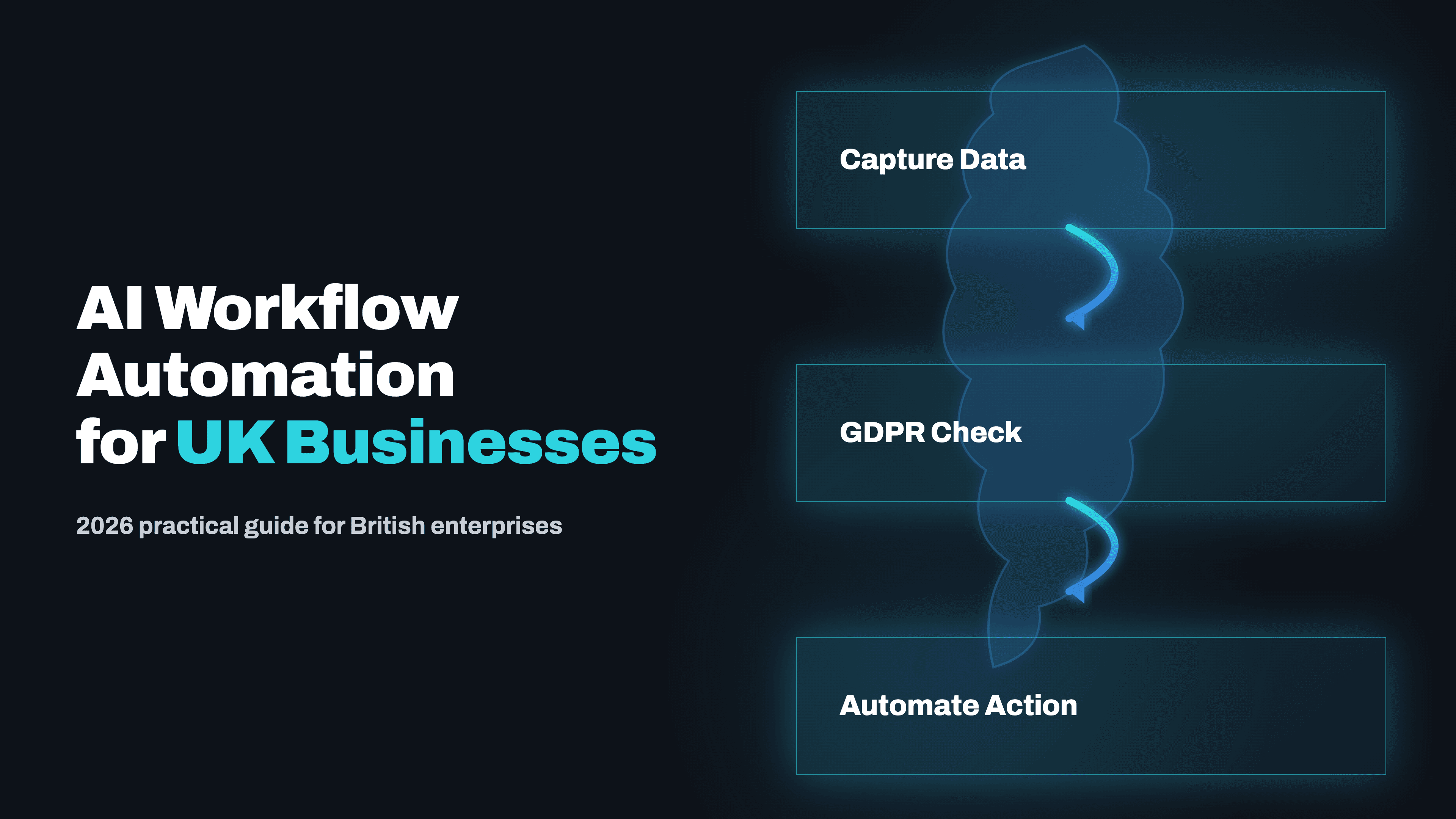
UK businesses face specific pressures in 2026, rising labour costs post-NLW increase, GDPR compliance requirements, and a skills gap in technical talent. AI workflow automation is the practical answer. Here's what's working, what's compliant, and how Kodesinc builds it.
In 2026, UK businesses are facing a specific combination of pressures that make AI workflow automation a business necessity rather than a technology experiment. The National Living Wage increase in April 2026 has raised the floor on labour costs across every sector. GDPR enforcement is tightening, with the ICO issuing larger fines and demanding demonstrable data minimisation. The technical talent market remains competitive, with mid-level developers commanding salaries that make manual, human-intensive operations increasingly hard to justify. Automation is how UK businesses absorb these pressures without reducing headcount or quality.
The UK-Specific Case for Automation
The April 2026 NLW increase to £12.21 per hour means that any manual process consuming more than a few hours per week per person has a straightforward automation ROI calculation. A three-person admin team spending 60% of their time on automatable tasks represents approximately £60,000–£80,000 of annual cost that could be partially or fully recovered through automation investment.
Beyond labour cost, IR35 reform has made it more expensive for UK businesses to use contractors for technical work, which is increasing the attractiveness of fixed-scope automation projects delivered by specialist agencies. The practical alternative to building automation capability in-house is partnering with an agency that has the tooling and institutional knowledge already.
GDPR-Compliant Automation: What It Actually Means for Workflow Design
GDPR compliance in automation is not a layer you add at the end, it's a design constraint from the start. Every automation workflow that processes personal data of UK or EU residents must have a lawful basis, must not retain data longer than necessary, and must be documented in your Records of Processing Activities.
In practice, this means workflows need to be designed with data minimisation in mind: process the minimum personal data fields required to complete the task, purge them from intermediate storage after processing, and log the lawful basis for each processing step. Processors established in the US need Standard Contractual Clauses (SCCs) or equivalent mechanisms to lawfully receive personal data from UK-based businesses. We build automation architectures with GDPR documentation as a deliverable, workflow maps that can be presented to your DPO and, if necessary, the ICO.
The Highest-ROI Use Cases for UK Businesses
Finance and accounts payable automation generates the clearest ROI for UK SMEs and mid-market businesses. A finance team processing 500 invoices per month manually is spending 60–80 hours on it. Automation reduces that to under 5 hours of exception handling. The workflow: ingest PDF invoices from email, extract supplier, amount, and line-item data using document AI, match against purchase orders, route for approval, and post to Xero, QuickBooks, or Sage.
- ✓HR and onboarding: Right to Work checks, HMRC PAYE registration, benefits enrolment, and equipment provisioning, all fully automatable with n8n
- ✓Customer communications: client onboarding, document collection, and engagement letter generation for professional services firms, high-volume, low-judgment tasks ideally suited to AI automation
- ✓Legal document handling: contract review pipelines that extract key clauses, flag non-standard terms against a template library, and generate a structured summary for the supervising solicitor, now deployable for firms of any size using Claude or GPT-4o
UK vs US Automation Maturity: Where UK Businesses Are Leaving Money on the Table
US businesses, particularly in tech, SaaS, and financial services, have been running production AI automation for 2–3 years longer than the UK average. The maturity gap is most visible in two areas: sales and outreach automation (UK businesses remain significantly more conservative about AI-personalised outreach, leaving pipeline velocity gains untapped) and internal knowledge management (US companies have widely deployed RAG-based internal knowledge bases; UK businesses are still mostly running on SharePoint).
The good news is that the infrastructure is now sufficiently proven that UK businesses can adopt without being early-adopter guinea pigs. The failure modes are well-documented, the compliance frameworks are established, and the tooling is mature.
How Kodesinc Works With UK Clients
Kodesinc operates on UK timezone for all active client engagements. We're familiar with the UK regulatory environment: ICO guidance, the UK GDPR framework, Companies House filing requirements, and HMRC digital reporting obligations (Making Tax Digital). Our engagements are fixed-scope with clear deliverables: a 2-week discovery and scoping phase, followed by a development phase delivered in defined sprints.
- ✓NLW cost pressure: automation ROI calculation is now straightforward for most UK admin-heavy processes
- ✓GDPR by design: every workflow we build includes data minimisation architecture and processing documentation
- ✓Finance automation: 500 invoices/month manually (60–80 hrs) reduced to under 5 hrs exception handling
- ✓HR onboarding: Right to Work, HMRC PAYE, and benefits enrolment automated end to end
- ✓UK timezone coverage: all client communications and support during GMT/BST hours
Making Tax Digital and the Automation Opportunity in UK Finance
HMRC's Making Tax Digital (MTD) programme is creating a specific automation opportunity for UK businesses. MTD for VAT is already mandatory for VAT-registered businesses above the threshold, and MTD for Income Tax Self-Assessment (ITSA) is expanding the requirement further. The businesses best positioned for MTD compliance are those with automated bookkeeping pipelines that pull transaction data from bank feeds, reconcile against accounting records in Xero or QuickBooks, flag exceptions, and generate MTD-compliant submissions without manual intervention.
For businesses still reconciling accounts manually, MTD deadlines are the forcing function to finally automate a process that should have been automated years ago. The automation build that addresses MTD compliance typically pays for itself in accountant time savings within the first year, independent of the compliance benefit.
n8n vs Make.com for UK Businesses: Which Fits Your Compliance Needs
UK businesses choosing between n8n and Make.com face a decision that goes beyond feature comparison. Make.com is a cloud-only SaaS platform: your workflow execution and intermediate data storage happens on Make's EU-region servers, which is GDPR-compatible for most use cases but limits your ability to guarantee data residency for sensitive workloads.
n8n can be self-hosted on your own UK infrastructure, AWS London region, Azure UK South, or an on-premise server, giving you complete control over where data sits during processing. For UK professional services firms handling client-confidential documents, healthcare providers with patient data, or financial services businesses under FCA scrutiny, the self-hosted architecture is often the only option that satisfies internal information security policy.
AI workflow automation is the practical response to the cost and compliance pressures UK businesses face in 2026. The technology is proven, the GDPR compliance framework is established, and the ROI for high-volume manual processes is well-evidenced. Book a free workflow audit and we'll show you exactly where the automation opportunity is before we write a single line of code.
Related Articles
n8n vs Make: An Honest Take After 80+ Client Automations
We've shipped automations on both n8n and Make for clients ranging from solo medical practices to enterprise logistics platforms. Here's the unfiltered verdict, including when we actively steer clients away from each one.
Read →
Why Gulf Enterprises Are Accelerating AI Automation in 2026
The pace of enterprise AI adoption in the Gulf has shifted dramatically in the past 18 months. Here's what's actually driving it, and what Kodesinc is building for clients in UAE, Saudi Arabia, and across the GCC.
Read →Want to implement this for your business?
Book a free strategy call. No commitment, no pitch deck — just a real conversation about your workflow.
Discuss Your Project →