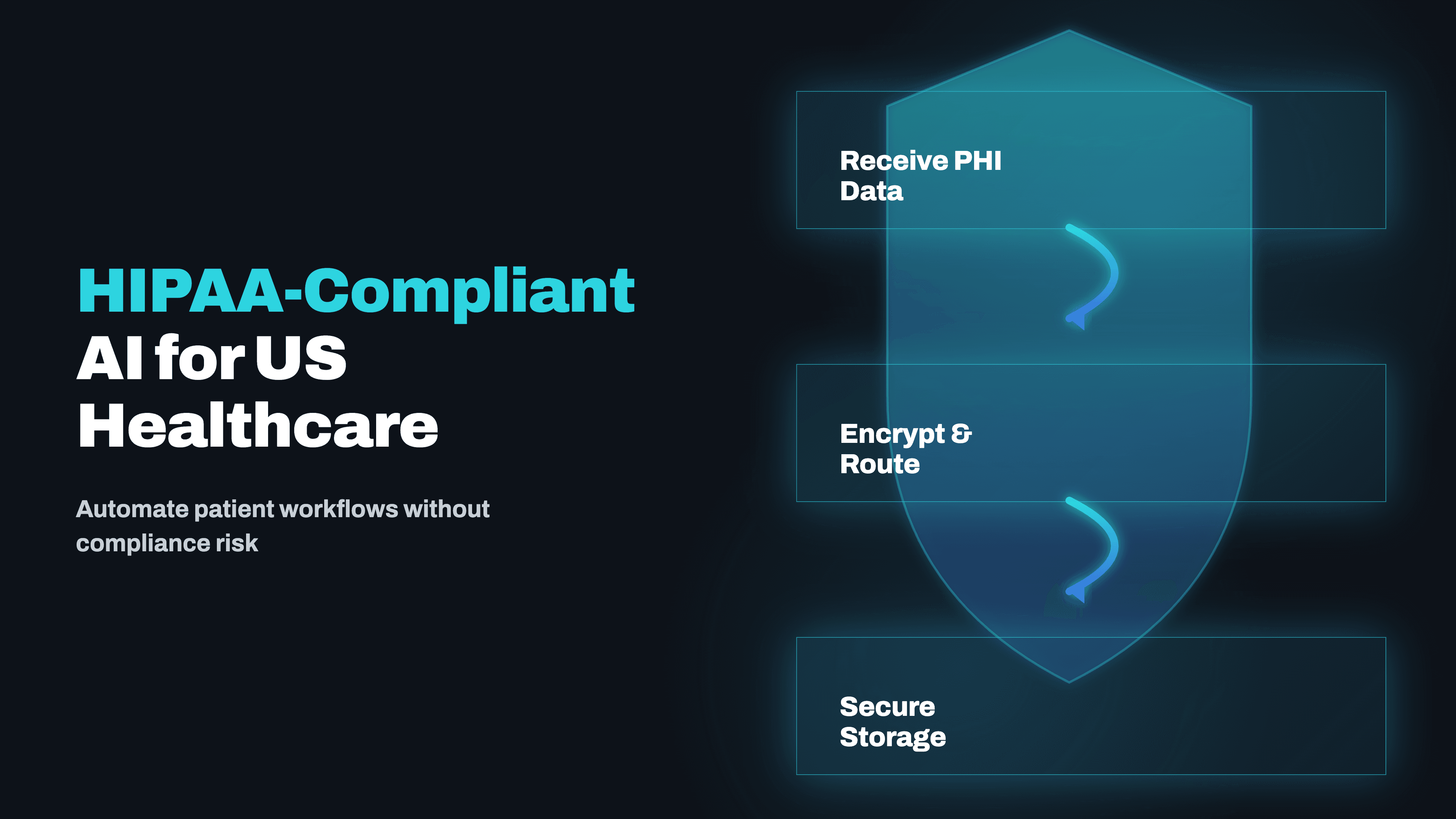
US healthcare teams spend 40%+ of admin time on tasks that can be automated, but HIPAA compliance stops most agencies from touching it. Here's exactly how compliant automation works, which workflows are safe, and what the integration stack looks like in production.
US healthcare automation is different from every other vertical, not because the technology is harder, but because the regulatory environment makes most agencies walk away before they start. HIPAA, Business Associate Agreements, EHR lock-in, and liability exposure create a barrier that keeps generic automation vendors out. At Kodesinc, we've built production healthcare automation systems for clinics, medical groups, and health tech platforms across the United States. Here's what's actually safe to automate, how the integration stack works, and what compliance really requires from a vendor.
Why US Healthcare Automation Is Different
The core constraint is HIPAA's Privacy and Security Rules, which govern how Protected Health Information (PHI) can be stored, transmitted, and processed. Any automation that touches PHI requires a signed Business Associate Agreement (BAA) with every vendor involved in that workflow, your automation platform, your LLM provider, your SMS vendor, and your cloud infrastructure.
- ✓AWS, Azure, and Google Cloud offer HIPAA BAAs
- ✓OpenAI offers a BAA for ChatGPT Enterprise and the API
- ✓Anthropic offers BAAs for Claude API enterprise customers
- ✓n8n Cloud offers a BAA on enterprise plans
- ✓Twilio offers a BAA for healthcare use
Every part of the stack has to be audited before a single automation goes live.
What Can Safely Be Automated Right Now
The workflows with the clearest automation path share two characteristics: they follow repeatable decision logic, and the PHI they handle is limited to specific, well-defined fields.
- ✓Patient intake: replacing paper or PDF forms with structured, AI-driven conversational flows that validate insurance eligibility in real time and push clean data directly into the EHR
- ✓Prior authorization: the average PA request takes 23 minutes of staff time; AI agents compress that to under 4 minutes by extracting relevant clinical criteria, matching against payer-specific coverage rules, and pre-filling submission forms
- ✓Appointment reminders: AI-personalized reminders outperform template sequences by 15–22% on no-show reduction in our client data
- ✓Billing follow-up: parsing ERA/EOB files, categorizing denials, prioritizing by dollar value, and drafting appeals; this is the workflow where most practices are leaving the most money on the table
How the Integration Stack Looks in Production
Healthcare automation lives and dies on EHR integration. The modern standard is HL7 FHIR APIs, Epic's App Orchard, Athenahealth's API platform, and Modernizing Medicine all expose FHIR R4 endpoints that allow authorized third-party systems to read and write patient data. FHIR gives you structured access to appointments, clinical notes, coverage information, and claim data without screen-scraping or file exports.
The automation orchestration layer sits on top: we use n8n (self-hosted or n8n Cloud Enterprise) for workflow logic, Python microservices for LLM calls where Claude or GPT-4o is processing clinical text, and Twilio (with BAA) for patient-facing SMS. Every data transmission is encrypted in transit and at rest. Audit logging captures every workflow execution, what data was accessed, what was written, and by which automated process.
What a BAA Actually Requires From an Automation Vendor
A BAA is a contract that binds a vendor to HIPAA's Security Rule requirements: administrative safeguards (policies, training, access controls), physical safeguards (data center security), and technical safeguards (encryption, audit controls, automatic logoff). A vendor signing a BAA is legally committing to these controls and accepting liability for breaches caused by their systems.
Before engaging any automation vendor for healthcare work, ask for their SOC 2 Type II report, their BAA template, and a list of subprocessors, sub-vendors who also handle PHI on their behalf.
Real Numbers: What Healthcare Automation Actually Delivers
- ✓Patient intake: 85% reduction in manual data entry time per new patient
- ✓Prior authorization: average handling time from 23 minutes to under 4 minutes
- ✓Appointment no-show rate: 15–22% reduction with AI-personalized reminder sequences
- ✓Billing follow-up: denied claims worked within 48 hours instead of 10–14 days
- ✓Revenue recovery: one orthopedic group recovered $340,000 in previously written-off claims in Q1 post-deployment
Common HIPAA Automation Mistakes to Avoid
The most common HIPAA automation failure is using a SaaS automation platform without verifying that a BAA can be executed with that vendor and every subprocessor in their stack. Make.com does not offer a HIPAA BAA on its standard plans. Zapier does not offer a BAA at all. Any healthcare automation built on these platforms and touching PHI is likely in violation, even if the underlying workflow logic is sound.
The second most common mistake is retaining PHI in intermediate workflow steps longer than necessary. An n8n workflow that processes patient data should not store that data in the workflow execution log in an identifiable form. HIPAA's minimum necessary standard applies to automated systems as much as to human processes. We design every healthcare workflow with data minimization as an architectural constraint, not a compliance afterthought.
Incident Response Planning for Healthcare Automation
HIPAA's Breach Notification Rule requires covered entities and business associates to notify patients, HHS, and in some cases the media within defined timelines when a breach of unsecured PHI occurs. Healthcare organizations that deploy automation without an incident response plan specific to their automated systems are taking on avoidable liability.
We include incident response documentation as a standard deliverable in every healthcare automation engagement: a data flow map showing exactly where PHI travels in the automated stack, a breach detection checklist tied to monitoring alerts, and a notification workflow that can be activated immediately if a breach is suspected.
HIPAA-compliant healthcare automation requires workflow mapping, BAA execution with every vendor in the stack, EHR sandbox access, and a deployment process that includes clinical staff validation. Our typical healthcare engagement is 6–8 weeks from kickoff to production. Book a free HIPAA automation audit, we'll map your workflows, identify what's safely automatable, and scope the BAA requirements before any code is written.
Related Articles
How AI Automation Cuts 40% of Admin Work in Medical Practices
Administrative overhead is the silent killer of medical practice profitability. Here's how AI automation is reclaiming hours every day across patient intake, prior auth, appointment reminders, and billing follow-ups.
Read →
Custom AI Agents vs Off-the-Shelf: When to Build, When to Buy
Every vendor will tell you their product handles your use case. Some of them are right. Here's an honest framework for deciding when a custom AI agent is worth the investment, and when buying an existing tool is the smarter call.
Read →
AI Workflow Automation Tools for Medical Offices: A Practical 2026 Guide
Medical offices are losing 20-30% of staff time to administrative tasks that AI workflow automation can handle, patient intake, billing, scheduling, referrals, and EHR data entry. Here's what's working in production in 2026 and how to implement it compliantly.
Read →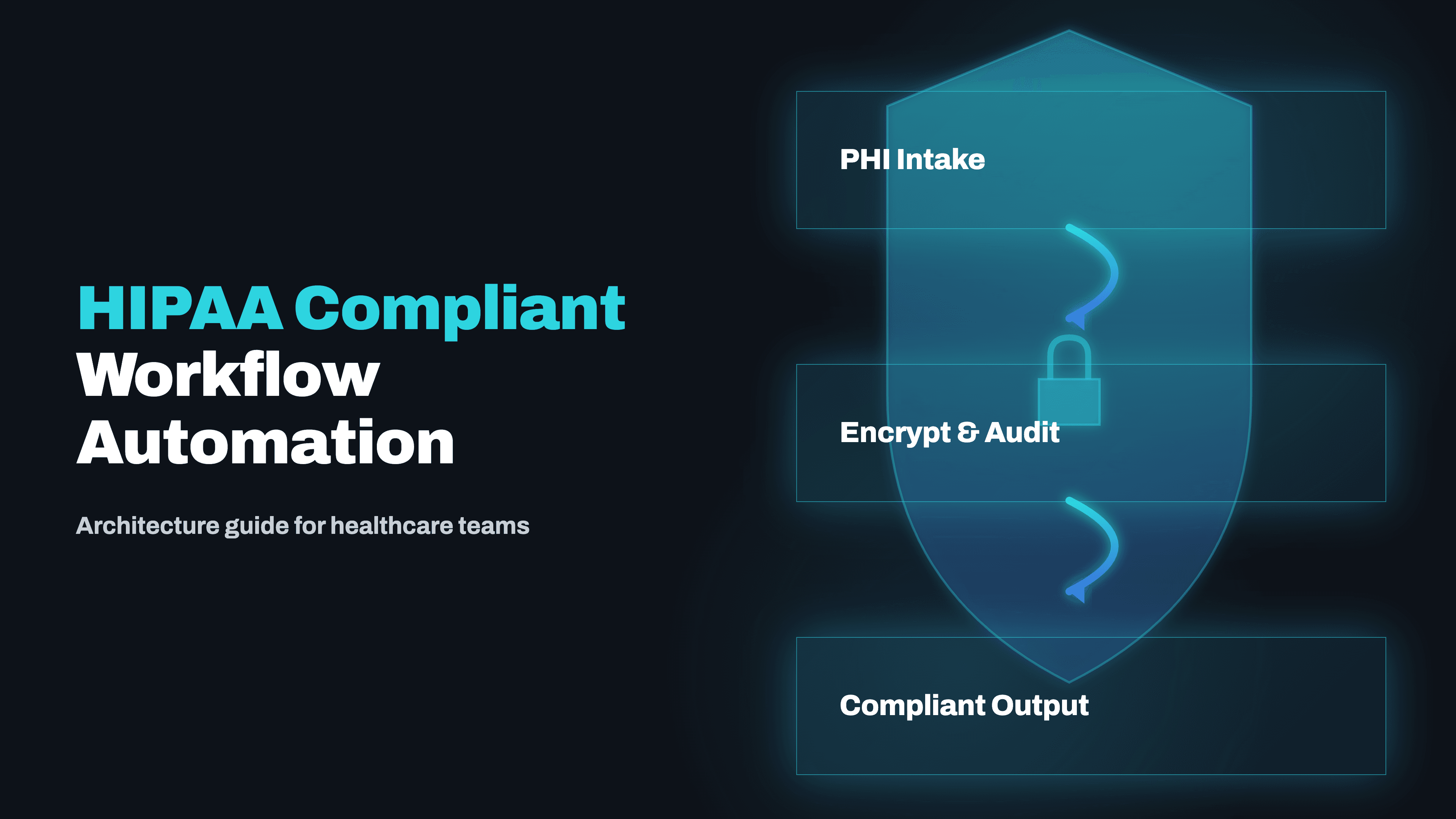
HIPAA Compliant Workflow Automation: Architecture Guide for Healthcare
Most healthcare workflow automation fails HIPAA compliance not because the tool is wrong but because the architecture is wrong. Here is what HIPAA actually requires of automated systems, which platforms can be made compliant, and how to design workflows that your DPO and legal team can sign off on.
Read →Want to implement this for your business?
Book a free strategy call. No commitment, no pitch deck — just a real conversation about your workflow.
Discuss Your Project →