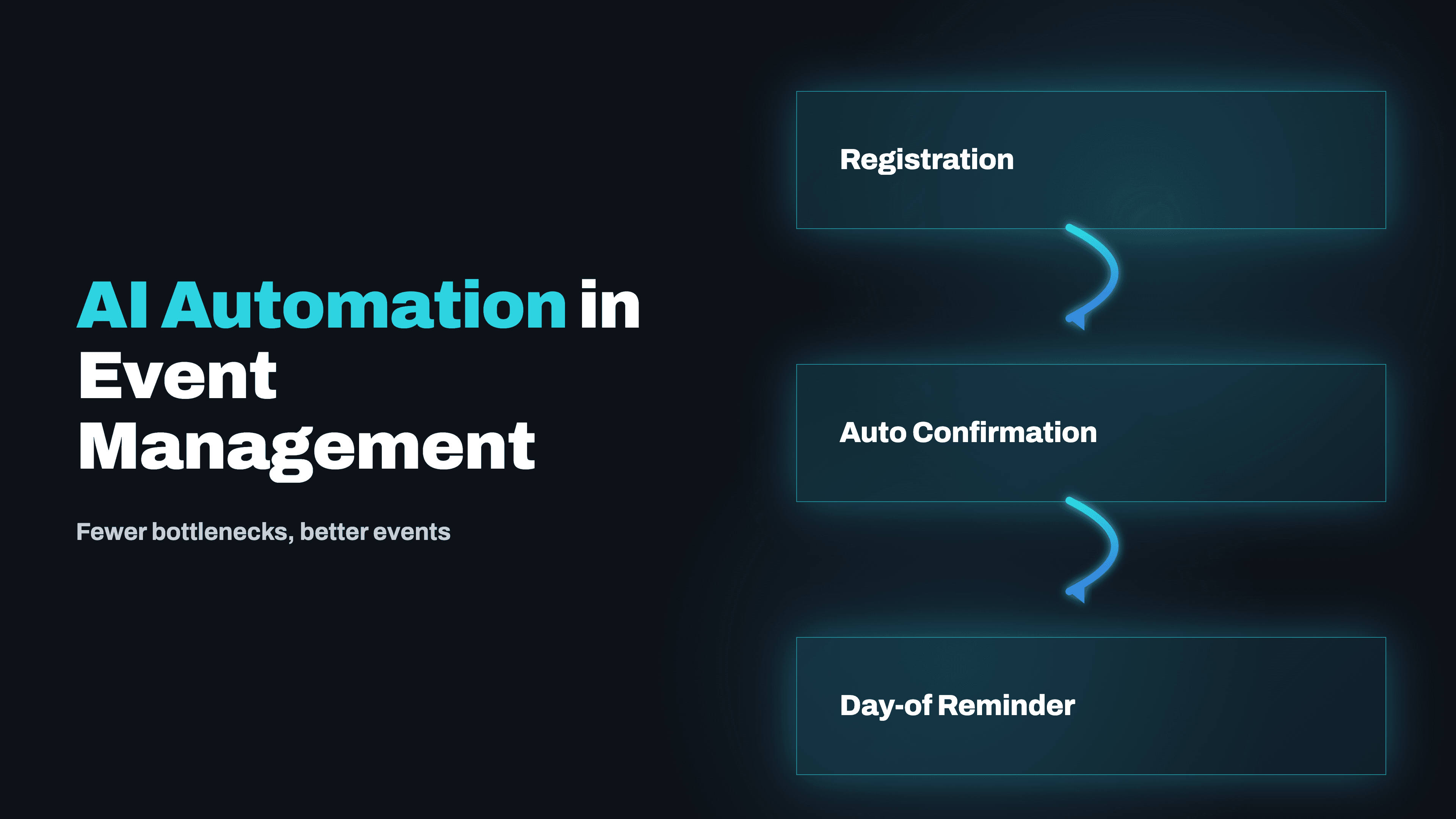
Event management runs on coordination, hundreds of moving pieces, tight deadlines, and zero tolerance for dropped balls. Here's what AI automation is actually changing, and not in the generic chatbot way you've heard about.
Event management is a coordination-heavy, deadline-driven industry that should be a natural fit for automation, and yet most event agencies are still running on spreadsheets, email threads, and tribal knowledge. We've built AI automation systems for event management clients handling everything from 200-person corporate conferences to multi-venue festivals with 15,000 attendees. Here's what actually works.
Venue Coordination: The Workflow No One Has Fixed Yet
Venue coordination involves a staggering amount of back-and-forth: availability checks, contract reviews, vendor confirmations, AV requirement lists, catering order changes, day-of timeline distribution. The bottleneck is almost always the same: a human coordinator sitting at the center of dozens of email threads, manually updating a master spreadsheet.
We replace this with a coordination hub, an n8n workflow that ingests emails from venue contacts, parses confirmation statuses using an LLM, updates a central database, and sends standardized follow-up messages when a response hasn't arrived within a defined window. The coordinator stops being a human router and starts being an exception handler.
Attendee Communications That Don't Feel Automated
Attendees have seen enough 'Hi {FIRST_NAME}' emails to be immune to them. Good automation is personalized at the segment level: speakers get different pre-event communications than general attendees, VIP guests get different logistics than remote participants. We build attendee communication pipelines that pull registration data, segment by registration type and engagement behavior, and generate personalized multi-touch sequences using an LLM with a system prompt that reflects the event's voice and brand.
Response rates on LLM-personalized event emails are consistently 20–35% higher than template-based sequences in our client data.
Real-Time Event Day Operations
Day-of coordination is where automations earn their keep. We've integrated AI-driven badge printing workflows that pull confirmed registration data, match it against real-time check-in scans, and flag discrepancies, duplicate check-ins, unregistered walk-ins, VIP guests who should be routed to a separate desk, in real time via a Slack channel that the operations team monitors. As rooms fill up, the system automatically updates the event app and sends overflow routing messages to attendees who haven't arrived yet.
Post-Event Reporting: From 3 Days to 3 Hours
Post-event reporting is the task every event team dreads. Attendance figures, session engagement metrics, sponsor deliverable reports, survey analysis, budget reconciliation, assembling a comprehensive post-event report used to take 2–3 days of manual data pulling.
We automate this end-to-end: attendance data from the check-in system API, session metrics from the event app, survey responses from Typeform or SurveyMonkey. An LLM stitches the narrative sections together based on structured data inputs. Reports that took 3 days now take 3 hours.
What the Stack Looks Like
- ✓Orchestration: n8n for workflow logic, with Zapier fallback for simple app-to-app syncs
- ✓Communications: Twilio for SMS, SendGrid for transactional email, WhatsApp Business API for international attendees
- ✓LLM layer: Claude or GPT-4o for personalization, summarization, and content generation
- ✓Data layer: Airtable or PostgreSQL as the event coordination hub
- ✓Reporting: automated Google Slides or Notion pages generated from structured data
The ROI Case for Event Automation
Event management automation is unusually easy to cost-justify because the labor costs are visible and the time savings are measurable. A mid-sized agency running 20 events per year, each requiring 40 hours of coordination admin, is spending 800 hours annually on work that automation can reduce by 60–70%. At a blended rate of $35/hour for coordinator time, that's $28,000 in recoverable capacity every year.
The build cost for a production automation system covering intake, communications, and reporting is typically $12,000–$25,000, with a payback period under 12 months in most cases. For larger agencies or in-house event teams running 50+ events per year, the math is even more compelling.
Starting Points and Common Mistakes
The most common mistake in event automation is trying to automate everything at once. The right starting point is a single, high-volume, high-pain workflow, typically attendee communications or post-event reporting, and building outward from there. Start with one event as a pilot, measure the time saved, refine the workflow, then roll it out across your event calendar.
The agencies that struggle are those that design the perfect automation system on a whiteboard and then try to deploy it for a major event with no time to test it against real data. Start small, iterate fast, and expand once the first workflow is reliable in production.
What AI Automation Cannot Replace in Event Management
Automation handles the repetitive, rule-based, and data-heavy parts of event coordination. It does not handle the relationship-intensive, judgment-dependent parts: negotiating with a difficult venue, managing a speaker who changes their requirements three days before the event, or making the call to pivot a session format when attendance patterns don't match expectations. The event coordinators who use automation most effectively are those who spend the time saved on the parts of their job that genuinely require human skill.
Sponsor and Exhibitor Management: The Overlooked Automation Opportunity
Event automation conversations focus heavily on attendees, but sponsor and exhibitor management is often the highest-value opportunity for large events. A conference with 50 exhibitors and 20 sponsors has a staggering amount of coordination overhead: booth assignment confirmations, AV specification collection, lead retrieval system onboarding, logo and asset collection for marketing materials, post-event deliverable reports.
We build exhibitor portal workflows that automate the entire lifecycle: a self-service portal where exhibitors submit their requirements, automated confirmation and reminder sequences tied to contract milestones, asset collection workflows that validate file formats before accepting submissions, and post-event reports generated automatically from check-in scan data. The event team stops being a coordination bottleneck and starts being a relationship manager for strategic sponsors.
If you're running an event management company or managing large corporate events in-house, the automation opportunities are substantial and the competition is still mostly running on spreadsheets. Reach out before your next major event cycle, Kodesinc has built end-to-end event automation systems for agencies in the US and UAE.
Related Articles
n8n vs Make: An Honest Take After 80+ Client Automations
We've shipped automations on both n8n and Make for clients ranging from solo medical practices to enterprise logistics platforms. Here's the unfiltered verdict, including when we actively steer clients away from each one.
Read →
Why Gulf Enterprises Are Accelerating AI Automation in 2026
The pace of enterprise AI adoption in the Gulf has shifted dramatically in the past 18 months. Here's what's actually driving it, and what Kodesinc is building for clients in UAE, Saudi Arabia, and across the GCC.
Read →Want to implement this for your business?
Book a free strategy call. No commitment, no pitch deck — just a real conversation about your workflow.
Discuss Your Project →